Solving for an Unknown in Equivalent Exponential Expressions
Solving for an Unknown in Equivalent Exponential Expressions
Some SAT math problems might look like equation-solving questions, but they are different in a key respect. These problems involve two expressions that are equivalent, which means they are just different forms of the same expression, so one expression can be algebraically transformed into the other through symbolic manipulation. Because the two expressions are actually the same, the expressions will be equal not just for one or more values of the variable(s) involved; they will be equal for all values of those variables (sometimes with a restriction to avoid division by zero). Sometimes, the problem will explicitly state that the two expressions are equivalent, but sometimes it will give an equation and state that it's valid for all values of the variable(s).
Here's an example involving exponential expressions.
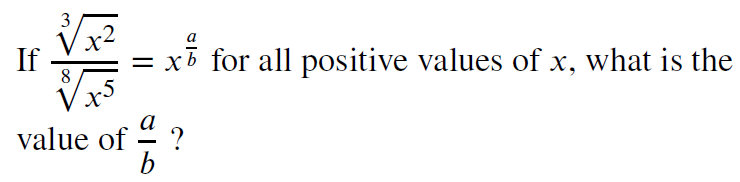
This is an equivalent expressions problem; though there's an equation, the problem states that the equation is true for all positive values of x. We'll first discuss and show a regression method for finding the solution, and we'll also present a graphing approach.
To solve this problem using regression, we can use a set of test values for x and ask Desmos to find the value of the unknown (here, a / b) that makes the given equation true for all the provided values of x. To ensure the exponential expression is uniquely specified, we need to use at least two test values (this corresponds to two points being required to determine the graph of an exponential function). The problem specifies that the expressions are equal for all positive values of x, so we'll use the test values 1 and 2. To set that up, we'll assign the list [1, 2] to the variable x₁ (recall that x and y cannot be assigned value because they represent graph axis variables), then we'll construct a regression that sets the two expressions equal.
Note that there are two unknowns in the given equation — a and b — so we include those in our first regression entry, and Desmos will find valid values. That allows us to then evaluate the solve-for expression a / b. However, the problem only asks for the ratio a / b, not the individual values (and indeed, they have n specific individual values, only a certain ratio), so we could replace that expression in our regression statement with a single variable if we wanted to save a few keystrokes and the additional entry needed to evaluate the solve-for expression; we show that more compact approach as well.
Though the answer, regardless of how it's arrived at, is equal to the fraction 1/24, Desmos doesn't find the values of a and b (or the single value v that represents a / b) with sufficient precision to convert its answer to that fraction, so if you use the regression approach, you'll only see a decimal answer with no option to convert it to a fraction.
For a graphing approach, you can enter each expression as separate entries so Desmos will graph their values on the y-axis, replacing a / b in the second expression with a single variable (we'll use v₂) and accepting the slider. You can then manipulate the slider to get the two graphs to match, but that will be very challenging here due to the solution value.
Here's another example of this type of problem:

We can solve this with regression by creating a system of equations with several test values of x. Again, we'll set up a list of test values in the variable x₁, respecting the given restriction that the variable must be greater than 1.
2 comments